
‘Monica’ Premieres at the Venice Film Festival
‘Monica’ begins in extreme closeup of a beautiful but unhappy woman. We do not know what makes her so unhappy; she is quiet, uncommunicative and lives in a sort of darkness, using her cel phone to call and to talk to people who do not answer her calls.
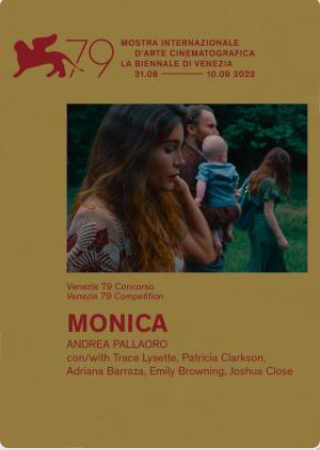
Opening as she is in a sun-tanning machine, the cinematography promotes the physical aspects of her life as her reality. She goes to her red convertible in a palmy sun-soaked Los Angeles and drives into middle America, her dyed red hair blowing in the breeze.
The film’s stillness, its low tenor dialogue when there is any, and the near lack of action make us gather pieces of the story more by induction than by its narrative. The moodiness of the story sets us into a receptive state to understand Monica is returning home to a world she has long left behind. She has a brother with a young wife and three young children. She has a mother who is dying. She also has a numbness to her that makes us feel numb ourselves.
We see her world and learn that she left home when a teenager and her mother left her off at the bus station and told her she could no longer be her mother. She returns not knowing if her mother will acknowledge her or even recognize her. But in the course of returning and connecting to her brother’s family, she finds a healing and the family finds a reconciliation of the sort we would all wish to make before our parents or siblings die. Solace comes from the everyday moments, normalcy in a time of despondency for all as the mother is dying but still living.
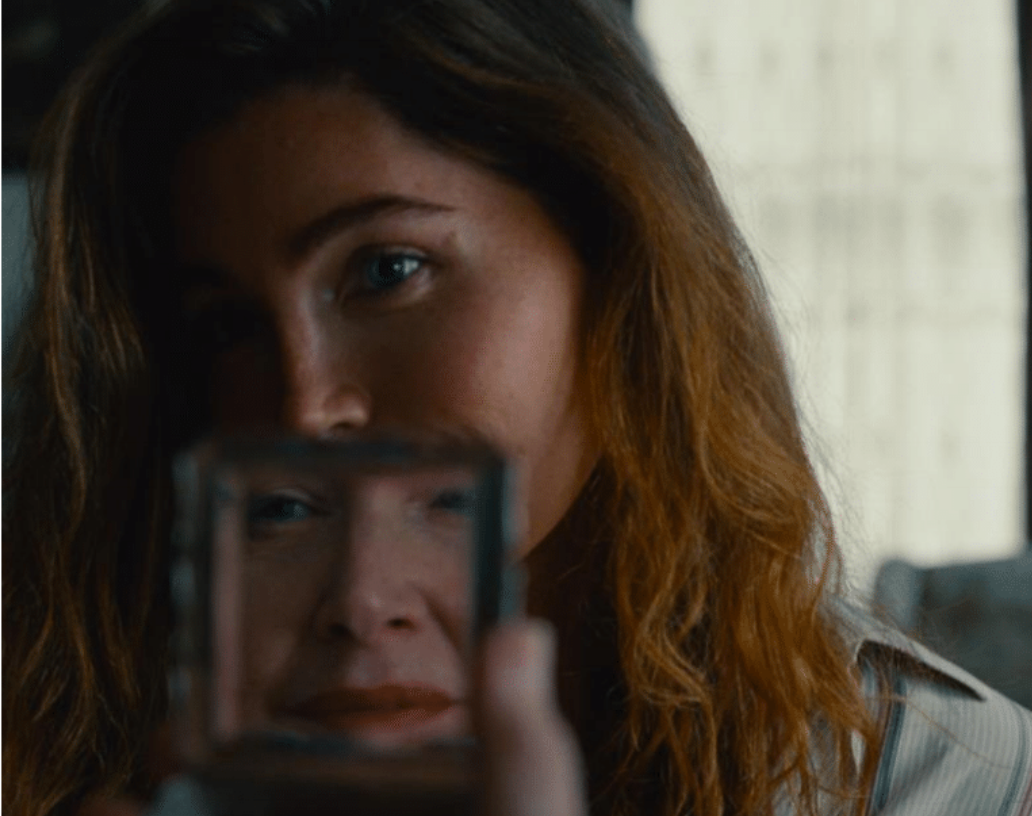
Andrea Pallaoro, the film’s director has a quiet and very sophisticated subtle way of delivering what we see as normal details in a way that delves into Monica’s internal world and state of mind. His earlier two films Medeas and Hannah, also have a feeling of not going anywhere as stillness and quiet predominate; but in the end, we know we have arrived at a different place.
He delivers an Italian arthouse feel to stories of almost normal, prosaic people leading lives of quiet desperation. This tattooed woman in a sun machine with her dyed red hair and red convertible, calling an estranged lover perhaps, calling people who do not return her calls, speaking with strangers and asking how they got her number, her massaging a man in her apartment, Is she a prostitute? She is a masseause but what sort…that is when the call comes from a sister-in-law she didn’t know she had, asking her to please come as her mother is dying and they need help with her and their own children.
Andreas has this to say about this particular film: During the past few years my mother’s illness has compelled me to confront my past and the psychological effects of abandonment. Treading between the interior and exterior, the emotional and physical, Monica explores the complexities of self-worth, the deep-rooted consequences of rejection and the lengths we go to heal our wounds. Through a cinematic language that stems from the juxtaposition of the aesthetics of intimacy and alienation, my creative team and I delved into the emotional and psychological landscape of Monica to reflect the precarious nature of self-identity when challenged by the need to survive and ultimately transform.
Andrea Pallaoro is no stranger to Venice. His first feature film, Medeas, premiered at the 70th Venice Film Festival in Orozzonti, the section for first and second time directors. It has won several awards at prestigious international film festivals including Marrakech, Tbilisi, Palm Springs, and CamerImage. And it has received positive reviews by serious critics and opinion makers. The New York Times’ Jeannette Catsoulis: “Capturing the poetry of bodies at rest and a landscape frozen in time,” in many ways describes Monica as well.
Hannah, Pallaoro’s second feature film, starring Charlotte Rampling, also world premiered in the Official Competition of the 74th Venice Film Festival where Ms. Rampling won the Coppa Volpi for best actress. Hannah went on to receive many prestigious international awards and recognition including a César nomination for best foreign film.
Born in Trento, Italy in 1982, Andrea Pallaoro holds an MFA in Film Directing from the California Institute of the Arts and a BA from Hampshire College. He splits his time between Los Angeles and New York City.
What is as interesting to me as the film itself, is how the producer, Eleonora Granata-Jenkinson come to make this film and how everyone worked together. It is even more interesting because I am a close friend of Eleonora. We met in a line to a movie at her first Sundance Film Festival and I later visited her in Italy when she was a buyer for RAI Cinema. She moved to LA and married one of the finest acquisitions persons in the business and had two sons. She works very closely with the producer Gina Resnick, another “long-timer”, one of the first women in the film business and like us, still at it. Eleonora and Gina produced Andrea’s first film as well.
That is what I wanted to talk to her about and what follows is here:
I know you produced Andrea’s first film Medeas. You told me to see it when we were at the Palm Springs Film Festival. How did you meet Andrea, and did you know immediately that he was so gifted?
Eleonora: Because I am one of the few Italian producers living in Los Angeles, I get to see a lot of amazing young people coming over with their dream and with a film, and friends of friends who say “You gotta watch this, you gotta watch that”. So a dear friend of mine, Laura Zumiani of Trentino Film Commission, though they didn’t have a Trentino Film Commission then, said to me, “There’s a guy that you need to to see, he’s living here in LA and he’s from Trento, and he’s a good friend of mine, and he’s really talented. And I said, “Oh my god, one more…ok…” So I watched his short, it was called Wunderkammer.
Andrea was studying at Cal Arts; it was his last year, and this was his graduate film. I said, “OK let’s watch this”. I was blown away. I had never seen such an incredible composition of photography; the camera moved in a swift and an incredibly crafted way. The story set was dark and I said ‘OMG, well maybe I’m overreacting’…I got so excited. You know when you find something, you say, ‘This is the thing!’…I call my friend Alessandra Venezia, the journalist, and I said, ‘Hey Alexandra’ (she’s my best friend) and I say, ‘am I crazy or is this guy got…’ I had a DVD because at that time it was what we had and I brought it to her. And she calls me back and says, ‘I watched it, oh my god, he’s incredible. Oh my god, Eleonora let’s go meet this guy’.
So I go, she couldn’t go, and I meet Andrea and Laura who’s Laura? Andrea is like one of the most sophisticated, amazing person you will meet. He’s kind, he’s funny, he’s gorgeous looking.
So I say OK, so he has this idea and we develop a little bit of the idea on Medeashis first film and I became the producer. But I needed a hands on producer and I grab my other best friend…I have a few best friends, you are one too [thank you]. They are my support and my life and my joy, that’s why we are in this business…and I said, ‘Gina I have this project…she says, ‘oh no! not a first timer!,’ but then she saw his short and so we did Medeas. Then I developed with Andrea the second film, Hannah, starring Charlotte Rampling but I didn’t produce it for him. .. long sotry but it was better not to produce it and so we concentrated on this one and that’s how Monica came to be.
It sounds simple. Was it really so simple?
Eleonora: The journey for this film was a very long one because of the issue of the film and because of the nature of Andrea’s films which are absolutely accomplished but not for a wide audience. Monica is the biggest film that Andrea has done. It’s in English, it’s shot in the United States and we have a marvelous cast. The film turned out to be incredible.
What about Venice?…
Medeas showed at Venice Orizzonti, the festival’s section for first and second time directors. Then it went on to other festivals and received praise from very serious critics and opinion makers. New York Times called it a “ravishing first feature”.
His second film, Hannah, also premiered in Venice. Naturally we are in a good relationship with Venice and we would never consider anything else…though there is no guarantee that we would be chosen to go again. I think they will like the next one too however. So here we are in Competition, on the first weekend.
That is great placement — the first weekend.
Yes as the people start to migrate to Toronto after the first half…though any time, any day or night is a great achievement to be in Venice. There are other phenomenal films there that did not go to Cannes. I believe this is going to be one of the best Competitions of Venice. We’re so proud to be there…
Andrea is in great company: Gianni Amelio, Darren Aronofsky, Noah Baumbach, Alice Diop, Inarritu, Luca Guadigno, Jafar Panahi, Frederick Wiseman, Laura Poitras, Florian Zeller — just to name a few, fabulous experienced directors.
Let’s talk a bit about Monica. There’s so little dialogue and there’s so little visibly going on and yet that serves to puts you into this receptive state and you get it at the end…it is all so interior… Medeas was also quietly interior. And both are dealing with such American every day life and environment, the the protagonist is always quite special herself (and always a woman).
What is his connection to US?
Eleonora: He is an Italian-American director who, as every one of us who has come to Hollywood from outside of the USA, has an idea of America which is a very personal creative and cultural experience.
The story of Monica is based on a real friend of Andrea who was a neighbor when he first moved here. She was a beautiful transgender woman who was kicked out of her family when she was 16 and came to Los Angeles.
What’s trans about Monica?
She is a woman reconnecting with family that she was shut out from. She is going on an interior journey back to her roots from which she emerges from her loneliness and rejection and finds the value of loving each other for who we are.
What is edifying is the social commitment of the film. It is about injustice and understanding in portraying women in whatever shape they are as belonging to humankind…it’s a very human experience. We consider this a post-trangender film about a transgender person played by a transgender actor…
Is the actress trans?
Tracee Lysette worked in many non-transgender roles, but came out publicly as trans through her role as Shea on the Amazon series Transparent. On the show, she plays a transgender yoga teacher and friend of Maura Pfefferman (Jeffrey Tambor). She also played in Hustlers alongside Jennifer Lopez, Cardi B and Constance Wu.
Tracee generated such an energy in a beautiful love story interrupted and disconnected that she is able to move forward. It is such a restrained, finely drawn role. I really believe the performance will go for a major award.
One wonders whether the mother will recognize her and accept her.
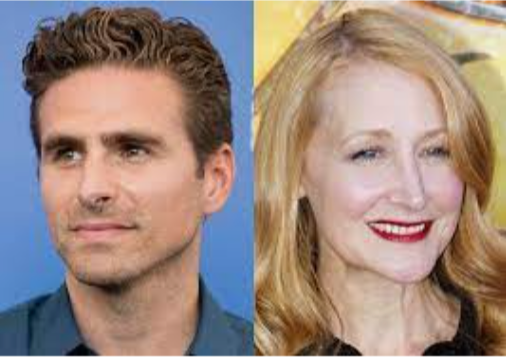
What about the other actors?
It was an unbelievable performance by Patricia Clarkson as the mother. She carried the film and with her own sensibility and her own personal view which so beautifully coinceded with Andreas’ vision. She supported the film all the way from its first steps through completion. She was always there for us.
Joshua Close, who plays the brother of Monica is coming out in Scorsese’s Killers of the Flower Moon playing opposite Leonardo di Caprio as his brother. He was great. Emily Browning is outstanding as the sister-in-law who calls Monica as she is giving the massage and tells her they need her to come back home where the mother is dying. And Adriana Barraza, one of the best actresses of Mexico, nominated for the Oscar for Best Performance by an Actress in a Supporting Role for Babel was incredible on the set, she brought such harmony.
The film was made on a very small budget and everyone had to pitch in to help it get made. The actors were all so supportive and helpful and Andrea actually produced the film with us. You should note aside from him there are only three producers: myself, Gina Resnick and Christina Dow.
I am a woman producer strongly believing in women supporting one another. Gina Resnick is not only a great hands-on producer but she stays through thick and thin. We of course are the closest friends as well. We must speak 20 times a day.
Even though it was a small budget, it was shot in 35 by a brilliant beautiful amazing DP, Katelin Arizmendi. Kate is just coming off of the 2nd unit forDune. She is a brilliant young woman — looks like a movie star and is working with a whole team of women, grip and everything . You will see them all when you come to Venice. They’re all coming, this crazy force of nature. Together they did a did a stunning film, stunning. You could take every frame of film and put it on the wall.
We’re very very excited about it.
What about distribution?
We have already been invited to a very significant film festival after this one. It will have a successful journey. Our sales agent is The Exchange. And UTA: I want to mention Rena Ronson — Rina, Gina and Eleonora…UTA did so much for us. We really joined forces. They set up all the screenings for finding a domestic US distributor who screened the film. After Venice and the reviews and others have weighed in, we will decide on our US plan.
I notice a huge number of coproducers and executive producers. There are 19. What is that about? It seems, actually to be a trend…Triangle of Sadnesshad 31 as do so many films these days…
The many executive and coproducers all believed in the script in spite of its difficult subject and they all significantly helped us put this film together. They were our best allies.
Our financial partner Felix and all the executive producers are worth mentioning. My own son, Matteo Jenkinson worked really closely with me to produce this film…
Andrea is a brilliant genius. Surrounded by such a cast and technical team, our Italian post-production help, the editor Paola Freddi; everyone went way above and beyond their designated roles with the film.
We even had help from the Italians with post-production by Propaganda Italia, Simone Gandolfo and a little financial support of the Ministero della Cultura (MiC) . And we have the best distributor in Italy today, I Wonder.
CREDITS
Directed by ANDREA PALLAORO
Written by ANDREA PALLAORO and ORLANDO TIRADO
Cinematographer KATELIN ARIZMENDI
Editor PAOLA FREDDI
Production Designer ANDREW CLARK
Costume designer PATRIK MILANI
Sound supervisor MIRKO PERRI
Produced by GINA RESNICK p.g.a., CHRISTINA DOW, ELEONORA GRANATA JENKINSON,
ANDREA PALLAORO
Co — produced by MARINA MARZOTTO a.g.i.c.i., MATTIA ODDONE, RICCARDO DI PASQUALE, GABRIELE ORICCHIO, ANTONIO ADINOLFI, GIORGIA LO SAVIO
Executive Producer — TRACE LYSETTE, ANDREI EPIFANOV, DAVID SCHWARZ, STEVE STANULIS, JOANA HENNING, STEPHANIE CASTAGNIER DUNN , ANTHONY BURNS, AMY GILLIAM, ERIC SCHNEDECKER, CHRISTINA SIBUL , KAREN TENKHOFF, ERIC COOK , MATTEO JENKINSON , BRIAN O’SHEA, NAT McCORMICK, DRU DAVIS, JULIEN P BOURGON , THEO VIELJEUX, ALI JAZAYERI, VIVIANA ZARRAGOITIA
Produced by VARIENT ENTERTAINMENT, SOLO FIVE PRODUCTION, MELOGRANO FILMS
Co-produced by PROPAGANDA ITALIA, FENIX ENTERTAINMENT with RAI CINEMA and ALACRAN PICTURES
In association with 039 ALBEDO, THE EXCHANGE, CINETRAIN and HUDSON ENTERTAINMENT GROUP
CAST & CREW
TRACE LYSETTE ⎜Monica
PATRICIA CLARKSON ⎜Eugenia
EMILY BROWNING ⎜ Laura
JOSHUA CLOSE ⎜ Paul
ADRIANA BARRAZA ⎜ Leticia
GRAHAM CALDWELL ⎜Brody
RUBY FRASER ⎜Britney
DIRECTOR OF PHOTOGRAPHY/ CAMERA OPERATOR — KATE ARIZMENDI
1ST ASSISTANT CAMERA — JASMINE CHANG
2nd ASSISTANT CAMERA — SAM STORM
1ST ASSISTANT DIRECTOR- LAURA KLEIN
2ND ASSISTANT DIRECTOR — ROGER MENDOZA
LINE PRODUCER — CHENNEY CHEN
UPM — ERIC COOK
PRODUCTION COORDINATOR — NICK AVERY, CRISTINA ARTEAGA
PRODUCTION SECRETARY- JESSICA MEEK
CASTING DIRECTOR (NY/LA) — EMILY SCHWEBER
LOCAL CASTING DIRECTOR — D. LYNN MEYERS
ASSISTANT CASTING DIRECTOR — ALI RAIZIN
ASSISTANT CASTING DIRECTOR CINCINNATI — BECCA SCHALL
COSTUME DESIGNER — PATRIK MILANI
ASST. COSTUME DESIGNER/ COSTUME SUPERVISOR — MARGAUX SOLANO
CHIEF LIGHTING TECHNICIAN — JAKE LYON
KEY GRIP — STEVE FORBES
BEST BOY GRIP — CHRISTOFER MOSCOSO
GRIP — RODNEY “ROCK” REED, ARIA BRICE, THOMAS VINCENT, JAKE STORM, PAUL FIERST, NICK PATTEN, MATTHEW BARNHART
HAIR/MAKE-UP DEPT HEAD — CHELO ACOSTA-CONLEY LOCATION MANAGER — ALAN FORBES
MUSIC CONSULTANT — ANGELA ASISTIO
PROP MASTER — LINNEA CRABTREE PRODUCTION DESIGNER — ANDREW CLARK SOUND MIXER — VIKTOR WEISZHAUPT, JOHNATHAN REECE


 Posts
Posts

